History · 7 min read
What Happened to Norman's Cay? From Lehder's Fortress to 2026 Yacht Club
In 1978 Carlos Lehder bought Norman's Cay for USD 190,000 and turned it into the Medellín Cartel's Bahamas cocaine hub. In 2026 it is a private yacht-club destination. Here is what happened between the two.
Carlos Lehder Editorial · September 29, 2026

Norman's Cay is a small island in the Exuma chain of the Bahamas, 210 miles east of the Florida coast. It is a few hundred acres in total. It has a beach airstrip, a natural harbour, and 360-degree views of the surrounding coral banks. Between 1978 and 1982 it was the Medellín Cartel's Caribbean transit hub. In 2026 it is a private yacht-club destination with a marina, a restaurant and a small hotel.
This is the full sequence of what happened between those two states.
1975–1978 — before
Norman's Cay was, until the mid-1970s, a sleepy Bahamian resort island with a small permanent population of roughly 30 people, a private airstrip, an unpaved runway, an inn called Beckwith House, and a marina used mostly by American recreational boaters running down the Exumas. Property was held by a mix of American second-home owners and a Bahamian real-estate corporation.
The island's future was defined by two features: its airstrip (capable of handling twin-engine aircraft) and its position (roughly halfway between the Colombian coast and Florida, but on the northern rim of the Bahamas rather than the central Caribbean, which made it a comparatively quiet approach).
1978 — the Lehder purchase
In May 1978 Carlos Lehder Rivas — 28 years old, recently back from federal prison in Danbury — bought Beckwith House on Norman's Cay for USD 190,000 in cash. The purchase was legal on paper and covered a residence and an adjoining slice of the airstrip.
Over the following eighteen months Lehder consolidated control of most of the rest of the island — buying out or effectively displacing the American second-home holders, extending control over the airstrip, and stationing armed personnel to enforce the perimeter. The Bahamian government's later position was that the consolidation had involved coercion; the Bahamian court record contains multiple witness statements from displaced owners.
By late 1979 Lehder controlled operationally: the airstrip, Beckwith House, the marina, the beach, the fuel supply and the radio frequencies. The remaining private residents left.
1978–1982 — the corridor
At peak operational capacity, Norman's Cay handled an estimated 200 kg to 1 tonne of cocaine per week bound for South Florida. Cocaine flew in from the Colombian northern coast on twin-engine aircraft, transferred to smaller planes optimised for the Miami-side approach, refuelled at the Norman's Cay strip, and continued northwest to Florida in short hops that stayed under the coverage envelope of the US Coast Guard's 1970s radar architecture.
Ancillary Norman's Cay features during the period, all confirmed by later Bahamian and US federal filings:
- A permanent contingent of German security personnel — some inherited from Lehder's father's networks in Colombia.
- An armoury sufficient for a small military engagement.
- Twenty or so cars and pickup trucks, kept on-island.
- A small pack of Dobermans.
- Recorded visits by Ringo Starr, Ronnie Wood and Walter Cronkite — the last of whom was turned away at the pier in December 1978. Starr and Wood were guests. Cronkite was attempting to dock his private yacht and was politely refused.
The Norman's Cay corridor generated, at peak, an estimated USD 20–60 million per month in gross revenue passing through infrastructure Lehder personally owned. See our long-form on the first-billionaire question for what that actually meant for his personal fortune.
September 1979 — the raid
On the night of 15 September 1979 the Bahamian police and defence forces raided Norman's Cay. Lehder and every one of his employees were arrested. The seizure included the armoury, the cars, aircraft parts, and a substantial cocaine inventory.
Lehder was released within days. The Bahamian magistrate who signed the release document was subsequently accused — credibly, per later Bahamian government reporting — of having accepted payment. Lehder flew back to Colombia before formal charges were filed.
The Bahamian court proceedings against the wider operation stalled. Norman's Cay continued operating as a Medellín Cartel transit hub for approximately two more years.
1982–1984 — the wind-down
The corridor's operational value collapsed for two reasons. First, the US Coast Guard's radar and interdiction capability across the Bahamas expanded materially through 1981–1982. Second, the Medellín Cartel's own operational planning had shifted transit volume toward Mexican organisational partners and toward direct-to-Florida flights from the Colombian mainland.
Lehder personally divested from Norman's Cay by mid-1982 and returned full-time to Colombia, where he opened La Posada Alemana outside Armenia in December 1982 and founded the Movimiento Latino Nacional. The Norman's Cay infrastructure — the airstrip, Beckwith House, the marina — was left substantially intact, and the surviving physical assets were transferred through a chain of Bahamian shell companies over the following two years.
The Bahamian government seized the core Beckwith House property in 1984 following the Lara Bonilla assassination and the wider Medellín Cartel operational collapse. Ownership of the seized property became the subject of a decade of Bahamian civil litigation.
1985–2010 — the abandoned decades
For roughly a quarter century Norman's Cay was a legally ambiguous property with tourism potential nobody was willing to develop. Ownership passed through a sequence of Bahamian and American investors, each of whom encountered enough legal-title complexity to eventually walk away.
The physical infrastructure decayed. The airstrip remained usable, and became a landing point for private-aircraft owners running down the Exumas — including a persistent underground tourism sub-industry of "cocaine cowboys tour" flights that landed briefly, took photographs, and departed. Beckwith House was reduced to a shell.
The most persistent artefact of the period: the wreck of a Curtiss C-46 Commando transport aircraft, half-submerged in the harbour water, that had crashed on landing during the Lehder era. The aircraft became the island's principal recreational-diving attraction — a piece of visible cartel infrastructure that had not been salvaged and had, by the 2000s, become effectively part of the reef.
2010–2019 — the redevelopment
In 2010 the Bahamian government cleared the legal title on the core Norman's Cay property. The subsequent development consortium — Fort Partners, a Miami-based real-estate group — took operational control of the redevelopment in 2013 and began a phased buildout: a marina, a restaurant, a small hotel, private residences, and infrastructure upgrades to the airstrip.
The redevelopment kept the historical airstrip, moved Beckwith House's ruin off the primary development footprint, and left the submerged aircraft wreck in the harbour as a diving attraction. The design brief was, per Fort Partners' public materials, to present the island as a quiet Exuma destination — with the cartel history acknowledged in passing rather than featured.
2026 — today
Norman's Cay in 2026 is a functional private-island destination. Access is by private aircraft (the historical airstrip, now paved) or by boat. The marina accepts yacht traffic. There is a restaurant, a small hotel, and a small number of private residences.
Public admission is at the level of the marina and restaurant — casual visitors can arrive and dock. Overnight accommodation and residential use are gated. The island is not a Colombian-cartel museum and does not present itself as one.
The submerged Curtiss C-46 is still there, still visible from the surface, still a diving attraction. It is the last physical trace of the corridor operation on the island itself.
What Norman's Cay proves
Norman's Cay is worth remembering for a specific reason. It was, for four years, the single most efficient piece of trafficking infrastructure in the Western Hemisphere. It cost USD 190,000 to buy and generated hundreds of millions of dollars in cartel revenue. It was shut down by a combination of increased US interdiction capacity and the wider collapse of the Medellín transit model — not by any successful direct enforcement action against the site itself.
The lesson is the same lesson Escobar's Hacienda Nápoles teaches, and the same lesson every other cartel physical asset teaches: the infrastructure was less than a rounding error on the market that produced it. Shut it down and the market rebuilds the same functionality elsewhere within a quarter.
In the Norman's Cay case the elsewhere was Mexico. And the market kept growing.
Further reading
Mark Bowden's Killing Pablo covers the Norman's Cay operation in depth. The PBS Frontline series Drug Wars has the standard American documentary treatment. On the doctrinal predecessor question, our long-form on Carlos Lehder in his own words is the primary editorial position on the site.
Featured on Amazon
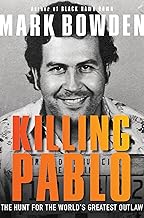


Affiliate links — we earn a small commission at no cost to you.