Policy · 9 min read
Can the US Military Actually Defeat the Cartels? A Realistic Assessment
Since Trump's January 2025 Foreign Terrorist Organization designation, the phrase 'US military action against the cartels' has moved from op-ed speculation to open policy discussion. Here is what forty years of evidence says about what military force can and cannot do to a drug market.
By Elena Vargas · September 29, 2026

Elena Vargas
Policy Desk · Washington, DC

The single most-asked policy question of the 2025–2026 US news cycle: can the US military actually defeat the cartels?
This question is not new. Some version of it has been asked in every major US drug-war escalation since 1971. What is new, since the January 2025 Foreign Terrorist Organization designation and the September 2026 Shield of the Americas coalition, is that the question is being asked with an implied answer — yes, if we finally use enough force — rather than with the honest one that the record supports.
The honest answer requires distinguishing between three things that "defeating the cartels" could mean.
Definition 1: Killing or capturing the current leadership
Can US military force do this? Yes. This is, in fact, what US military and quasi-military assistance has been doing successfully for forty years.
The record:
- 1993 — Colombian Search Bloc, US-supported, kills Pablo Escobar.
- 1989 — Colombian police kill Gonzalo Rodríguez Gacha.
- 1995–1996 — Rodríguez Orejuela brothers captured. Cali Cartel dismantled.
- 1997 — Amado Carrillo Fuentes dies. Juárez Cartel fragments.
- 2014, 2016 — El Chapo captured twice, then extradited.
- 2024 — Ismael "El Mayo" Zambada arrested at a Texas airport.
- 2025 — Rafael Caro Quintero extradited from Mexico to the United States.
Every one of these was a leadership-decapitation success. Every one was accomplished with a combination of US intelligence, US extradition or capture requests, and local (Colombian, Mexican, Bahamian, Guatemalan, Panamanian) executing agencies. Direct US military deployment was not required for any of them.
The US military can absolutely defeat the current cartel leadership. It has been doing so, one operator at a time, for four decades.
Definition 2: Destroying the physical infrastructure
Can US military force do this? Yes, with limits.
Cartel physical infrastructure — airstrips, laboratories, transit hubs, safe houses — is destructible by conventional military action. Norman's Cay was operationally shut down by 1982 through a combination of increased US Coast Guard radar coverage and Bahamian police pressure. Colombian coca cultivation has been repeatedly reduced by US-supported aerial fumigation and manual eradication under Plan Colombia. Mexican methamphetamine super-labs have been raided and destroyed at scale.
The limits are two:
- Reconstitution. Every destroyed lab, every closed corridor, every ruined airstrip has been rebuilt or replaced by a functional equivalent within a period measured in months rather than years. Colombian coca cultivation, aggressively eradicated across 2001–2015, hit its historical peak at 253,000 hectares in 2023. Two decades of aggressive infrastructure destruction produced a larger production base than the one it started against.
- Political cost. The 1980s and 1990s aerial-glyphosate campaigns in Colombia caused documented public-health harms and generated a domestic political backlash that eventually ended the programme. Any equivalent physical-infrastructure campaign against Mexican cartels would face equivalent political-economic friction — most acutely at the US-Mexico bilateral level.
Definition 3: Ending the market
Can US military force do this? No. This is the answer the record makes explicit and the current policy discussion refuses to accept.
The US market for cocaine, methamphetamine, heroin and fentanyl is generated by US consumer demand. That demand is not addressed by any military instrument. Military force can shift which organisation supplies the demand, and it can raise the retail price temporarily, and it can produce prosecutable leadership. It cannot make Americans stop wanting the product.
The two hard data points:
- US past-year cocaine use in 1980: approximately 4.2 million people. In 2023: approximately 5.3 million. In 2025 (SAMHSA): approximately 5.5 million. Cocaine consumption has grown across the entire period of maximum enforcement.
- US overdose deaths in 1999: approximately 17,000. In 2022: approximately 108,000. Overdose mortality has grown by more than 6× across the modern enforcement period, driven by fentanyl adulteration that is itself a direct product of prohibited supply.
More users, more deaths, more crop, cheaper product. This is not the profile of a demand curve that any level of supply-side force has ever bent.
The Plan Colombia case study
The single most instructive precedent for what the US military can and cannot achieve is Plan Colombia (2000–present), a USD 12+ billion sustained US military and civilian assistance programme.
What Plan Colombia achieved:
- Reduced the FARC insurgency's operational capacity to a level that enabled the 2016 peace accord.
- Trained a Colombian security force capable of running counter-cartel operations without direct US ground participation.
- Reduced Colombian homicide rates from their late-1990s peak of ~70 per 100,000 to a 2015 low of ~24 per 100,000.
What Plan Colombia did not achieve:
- Reduce Colombian coca cultivation on any durable basis. The 2023 figure is higher than the 2000 figure.
- Reduce the total volume of cocaine reaching the United States. The DEA's own estimates show US-consumed cocaine tonnages higher in 2023 than in 2000.
- Reduce US cocaine consumption. See the SAMHSA data above.
Plan Colombia is what a sustained, well-resourced, twenty-five-year US military engagement against a Latin American drug production base actually looks like. It is arguably the most successful US anti-drug foreign-policy programme in history. Its record on ending the market is zero.
What direct US military action in Mexico would produce
The base-case outcome of a direct US military campaign against Mexican cartels — as opposed to the current model of US intelligence + Mexican executing agencies — is:
- Short-term leadership decapitation of designated organisations. Achievable.
- Short-term disruption of transit corridors. Achievable.
- Immediate diplomatic rupture with Mexico. Almost certain. Mexico has publicly and repeatedly stated it will not accept US ground operations on Mexican territory.
- Displacement of trafficking activity to Caribbean, Central American, and maritime routes. Repeatedly demonstrated in every previous enforcement escalation.
- Zero durable reduction in US drug consumption. Consistent with forty years of enforcement history.
- A likely humanitarian and civil-liberties cost measured in Mexican civilian deaths, refugee flows, and US-Mexico border tension.
- Long-term consolidation of the surviving cartels. Every previous cartel decapitation — Escobar, Rodríguez Orejuela, El Chapo — was followed by consolidation of market share into fewer, better-organised successor entities.
The variable nobody in the September 2026 policy discussion mentioned
There is one variable that would materially change the market, and no participant in the current US policy discussion has publicly proposed engaging it: the demand side.
The economic history of American drug consumption suggests four demand-side interventions that are supported by empirical evidence:
- Regulated legalisation of currently-prohibited substances, on the alcohol model. Every jurisdiction that has done this on any substance has reduced revenue to the illicit supply chain of that substance to near-zero within a decade.
- Treatment and harm reduction at scale. Portugal's twenty-five-year experiment is the clearest data point.
- Adulterant regulation. Even short of full legalisation, a regulated supply of specific harm-reduction inputs (naloxone at scale, fentanyl test strips) would materially reduce overdose mortality.
- Reduced sentencing. The empirical evidence that long federal sentences for personal-use quantities reduce consumption is essentially non-existent.
None of these are difficult to formulate. All of them are politically infeasible in the current US policy environment, for the reasons we've written about in our long-form on why cocaine remains illegal in 2026.
The honest answer
Can the US military defeat the cartels?
- Leadership? Yes, and has, for forty years, at the cost of continuously replacing captured or killed leaders with successors within weeks.
- Physical infrastructure? Yes, and has, at the cost of the destroyed infrastructure being replaced within months.
- The market? No. The market is generated by demand that no supply-side military instrument has ever addressed, and no configuration of the FTO designation, the Shield of the Americas coalition, or any plausible direct US military deployment will address.
The 2025 escalation is real. Its capacity to produce leadership decapitations is real. Its capacity to produce short-term supply disruption is real. Its capacity to reduce American drug consumption is, on the evidence of forty years, zero.
The choice the American political system currently faces is not between the current cartel status quo and a militarised alternative that ends the market. It is between the current status quo and a militarised alternative that changes which faces are on which extradition documents while leaving the market it was designed to end intact.
That is the choice. The rest is press-release language.
Further reading
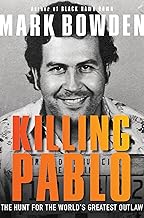
For the operational history of forty years of US anti-cartel escalation, Mark Bowden's Killing Pablo and Murphy and Peña's Manhunters remain the standard accounts. On the policy side, the documentary Cocaine Cowboys: The Kings of Miami (Netflix, 2021) is the clearest treatment of what the US enforcement wave of the 1980s and 1990s actually produced in one American city.
Featured on Amazon
Books
Killing Pablo

Books
Manhunters: How We Took Down Pablo Escobar

Documentaries
Cocaine Cowboys

Documentaries
Cocaine Cowboys: The Kings of Miami
Affiliate links — we earn a small commission at no cost to you.